Posts Tagged ‘classroom’

Research supporting collaborative, enquiry-based learning.

Welcome back!
I'm currently in Turkey with Nick Dennis presenting about technology to History educators at the request of EUROCLIO. Resources (in Turkish!) here...

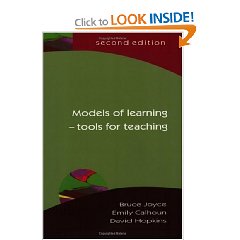
Model of Learning - Tools for TeachingOne of the great things of studying in the Education Library at Durham University (instead of at home, in my study) is the books I randomly stumble across. For example, I pulled Models of Learning – Tools for Teaching off the shelf today and it fell open at Chapter 7, entitled ‘Learning through cooperative disciplined inquiry.’

This is perfect for me. One of my Performance Management targets for this year – the one focused on my own classroom practices – is about piloting enquiry-based learning with one of my Year 7 History classes. In addition, I’ll (hopefully) be presenting with Nick Dennis at the SHP Conference in July 2010 on this very topic – including the way technology can help! :-p

It’s always good to have some scholarly research to back up one’s actions, so if you’re planning to do something similar here’s some quotations to help you!

The most stunning thing about teaching people to help kids learn cooperatively is that people don’t know how to do it as a consequence of their own schools and life in this society. And, if anything is genetically driven, it’s a social instinct. If it weren’t for each other, we wouldn’t even know who we are. (Herbert Thelen to Bruce Joyce, circa 1964) p.95

The chapter is based on case studies across the age range, but also contains this nugget on p.98-9:

The assumptions that underlie the development of cooperative learning communities are straightforward:

  1. The synergy generated in cooperative settings generates more motivation than do individualistic, competitive environments. Integrative social groups are, in effect, more than the sume of their parts. The feelings of connectedness produce positive energy.
  2. The members of cooperative groups learn from one another. Each learner has more helping hands than in a structure that generates isolation.
  3. Interacting with one another produces cognitive as well as social complexity, creating more intellectual activity that increases learning when contrasted with solitary study.
  4. Cooperation increases positive feelings towards one another, reduces alienation and loneliness, builds relationships, and provides affirmative views of other people.
  5. Cooperation increases self-esteem not only through increased learning but through the feeling of being respected and cared for by others in the environment.
  6. Students can respond to experience in tasks requiring cooperation by increasing their capacity to work together productively. In other words, the more children are given the opportunity to work together, the better they get at it, with benefit to their general social skills.
  7. Students, including primary school children, can learn from training to increase their ability to work together.

The authors go on to summarise the evidence about improved learning through collaboration on p.99:

Classrooms where students work in pairs and larger groups… are characterized by greater mastery of material than the common individual-study/recitation pattern. Also, the shared responsibility and interaction produce more positive feelings toward tasks… In other words, the results generally affirm the assumptions that underlie the use of cooperative learning methods.

It’s not hard to get started with cooperative learning (p.100):

[A]n endearing feature is that it is so very easy to organize students into pairs and triads. And it gets effects immediately. The combination of social support and the increase in cognitive complexity caused by the social interaction have mild but rapid effects on the learning of content and skills.

The authors dismiss claims from some teachers that ‘gifted students prefer to work alone’ as the evidence does not back this up (Joyce 1991; Slavin 1991). They believe it may rest on a misunderstanding of the relationship between individual and cooperative study; partnership still requires individual effort. There’s no need to be concerned about students’ ability to work together (p.101):

In fact, partnership s over simple tasks are not very demanding of social skills. Most students are quite capable of cooperating when they are clear about what has been asked of them.
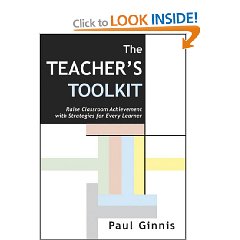
The Teacher's ToolkitI’ll not go into them here, but the authors mention a number of ways in which teachers can foster ‘positive interdependence’. They also suggest the ‘division of labour’ into specializations. Instead of learning only a part of what every is supposed to be learning, they have found, ‘jigsaw’ activities and the like lead to more learning across the spectrum. Many of the activities they suggest are, in fact, featured alongside others in one of my favourite education-related books, The Teacher’s Toolkit.

The teacher’s role in cooperative learning moves from that of instructor to ‘counsellor, consultant and friendly critic.’ (p.107) The authors note that this ‘is a very difficult and sensitive’ role ‘because the essence of inquiry is student activity’. Teachers need to:

  • facilitate the group process
  • intervene in the group to channel its energy into potentially educative activities, and
  • supervise these educative activities so that personal meaning comes from the experience

The upshot of this is that ‘intervention by the teacher should be minimal unless the group bogs down seriously’ (p.107).

The authors suggest a 6-phase process for cooperative learning:

Phase 1 – Students encounter puzzling situation (planned or unplanned).

Phase 2 – Students explore reactions to the situation.

Phase 3 – Students formulate study task and organize for study (problem definition, role, assignments, etc.)

Phase 4 – Independent and group study.

Phase 5 - Students analyse progress and process.

Phase 6 – Recycle activity.

In conclusion, the authors note how universally cooperative group investigation can be used (p.111-2):

Group investigation is a highly versatile and comprehensive model of learning and teaching: it blends the goals of academic inquiry, social integration and social process learning. It can be used in all subject areas, and with all age levels, when the teacher desires to emphasize the formulation and problem-solving aspects of knowledge rather than the intake of preorganized, predetermined information.

Posted: November 28th, 2009
Categories: Education
Tags: , , , , , , , ,
Comments: View Comments.

Design the (e-)book cover for #movemeon!

I’m very pleased to see that other educators have run with the #movemeon idea I floated. There are now literally hundreds of tweets that have been tagged – you can view them in real-time here, or an archive here.

My favourite way of viewing them, is via visibletweets.com using the ‘rotation’ animation:

#movemeon viewed with visibletweets.com

Once we reach a significant number of tweets – I suggested 1,000 – then I’m going to collate them. Using the self-publishing service Lulu.com there will be a freely-downloadable e-book along with a book purchasable at cost price. :-D

I’ve put together a wiki at http://movemeon.wikispaces.com to depersonalise things – it’s about the ideas and the collaboration, not me, after all! You’ll find the same links as I’ve given above over there.

We do, of course, need a cover for the book and so it’s time to crowdsource that. On the wiki is a page with a template to provide your contribution. You know you can do better than my feeble effort, provided to get things started:

#movemeon cover idea

Please do share this with as many people as possible. Not only would I like the book to look as good as it can, but I’d like to make sure that as many educators as possible can tap into the wealth of tips and ideas that have been shared. I’ve certainly learned a lot! :-D

Posted: November 26th, 2009
Categories: Education
Tags: , , , , , , , , , , ,
Comments: View Comments.

How I mark students’ books.

Marking books

I’d love to mark blogs (or even Google Wave) rather than exercise books. In my previous school I used Posterous-powered blogs with my Year 10 History class. However, in some situations it’s just not practical for various reasons. This isn’t the post to go into the ins and outs of why this is the case. This is the post that explains how I mark books with some justification behind my actions. One reason for putting my system online is to get feedback as to how I can improve it.

Let me just say right from the outset that I don’t mark as often as other teachers. Or as often as they claim to, anyway. In fact, during these half-term holidays is the first time I’ve marked my classes’ books this year. I would have ordinarily have liked to look at them before now (after 2-3 lessons) but setting up a new Academy kind eats into any free time you’ve got…

One more thing by way of context. It’s usual, but not universal, in England for Key Stage 3 students – whom I’m talking about here – to get one lesson of History (my subject) per week. Marking their books at the end of the half-term means they’ve got a maximum of 6 lessons work in there.

With that out of the way, let me explain how I go about marking. I do it in two ‘waves’:

First wave

Crap at History?

In the first wave I’m concentrating on the following:

  • Encouraging students
  • Completion of work
  • Understanding of key concepts
  • Spelling of key words
  • Factual errors (to correct)

If I notice a pattern across books (either all or a subset of them) then this informs my teaching and/or direction of Learning Support Assistants.

I used to mark in green, after hearing that some students find red a ‘confrontational’ colour. However, after having students in two separate schools complain about this, I’m back on the red. That’s handy, as green pens are more expensive and harder to get hold of!

Sometimes I fall into the trap of ‘ticking’ work. There’s really no point in this, but I do it to reassure students that I’ve seen a piece of work that doesn’t really require any comment. I focus my time and effort on things that are likely to make a difference to their learning. Sometimes this is reinforcing/correcting understanding of a key concept; sometime it’s encouraging a student; sometimes it’s drawing attention to spelling of key words. It depends on what you’re teaching and who the student is.

Second wave

Marking: the Second Wave

Once I’ve been through exercise books with a red pen, I revisit them (the ’second wave’). The purpose of this is to:

  • Make a summative comment on how each individual student is doing.
  • Inform the student on work that’s missing from their book.
  • Highlight 3 ways they can improve.
  • Enter data into a grid showing homework completion.
  • Add notes, comments and indicative levels to my (online, Google Docs-powered) gradebook

Before I started to do this (or an iteration of it) I noticed that students wouldn’t read the comments I made on books. Having an obvious bookmark (such as that provided by the full-page feedback) gets them reading what I’ve said. By observing a colleague at my previous school I’ve also realised the importance of building time into a subsequent lesson to let them read what you’ve said. :-p

Conclusion

This marking system takes time. The thing that actually takes the most time is the chasing up of books that haven’t been handed in for marking, students who haven’t completed homework, and monitoring the catch-up work of absentees. Once students get used to the system, however, they seem to like it. After all, they know that I’ve been through their books carefully and given personalised feedback. They appreciate that. :-)

Comments? Suggestions? Use the comments section below!

Posted: October 27th, 2009
Categories: Education
Tags: , , , , , ,
Comments: View Comments.

3 ways Google Wave could be used in the classroom.

Google Wave logo

So you’re an educator who’s managed to score an invitation to Google Wave. You’ve had a play and it’s all very nice, but how could it be used in education?

Before I go any further, read these:

Google Wave conversation

Here are 3 ways I think Google Wave could be used by students for actual learning rather than just playing with something because it’s cool.

1. Empowering learners

There was a great presentation at the TeachMeet that accompanied the Scottish Learning Festival this year. Fearghal Kelly talked about his experiments with giving one of his classes more ownership over their learning. He ran them through the learning objectives and the content they would need to cover and then the student co-created and collaborated on planning what exactly they wanted to do.

Google Wave would be great for this as it allows wiki-like editing but is more threaded and conversation-like. The whole wave can also be ‘replayed’ to see how the thinking of the group evolved over time. It’s something I’d definitely be trying if I had a GCSE or AS/A2-level class… :-p

2. Student feedback

The most powerful learning experiences are those where students have ownership of their learning. That’s been dealt with above. But that’s of no use if students don’t know how to get better in a particular subject or discipline!

That’s why I think Google Wave could be used as an Assessment for Learning tool. Learning as a conversation could be shown in practice through having an individual wave for each student/teacher relationship. Alternatively, these could be small group and ability based to enable peer learning.

I can imagine waves being used for ongoing learning conversations once Google Wave becomes a feature of Google Apps for Education. I’ll certainly be experimenting with it for that purpose! :-D

3. Flattening the walls of the classroom

One of the really exciting things about Google Wave is the ‘bots’ you can add to automate processes. One of these bots allows for the automatic translation of text entered in one language into that of the recipient.

Whilst language teachers may be up in arms about the idea of ‘not needing’ to learn another’s language, I think it could be fantastic for removing barriers for worldwide collaboration. Imagine the power of students having the digital and wave-equivalent of ‘penpals’ in various classrooms around the world.

Now that really would ‘flatten the walls‘ of the classroom. :-)

What excites YOU about Google Wave’s potential for education?

Related articles by Zemanta

Reblog this post [with Zemanta]

A Tale of Two Guest Houses (or, what are you offering your students this academic year?)

I’ve been in Devon this past week. Driving back from Exeter to my inlaws’ house I passed the signs for two guest houses:

Guest house with hot tub and wi-fi

Guest house with 'central heating'!

It got me thinking about the differences in educational opportunities being offered at various schools not only in the same country, but around the world. No doubt, the reason why the guest house at the top in the pictures above is successful is because of the bells and whistles it offers. I should imagine they could get away with relatively poor customer service and offering a ’rounded’ experience as they offer the ‘wow’ factor.

The bottom guest house in the pictures above  is probably still in business due to the personality of the proprietors. The fact that they’re still advertising having central heating and a TV shows how behind the times they are, yet they must offer something the others don’t otherwise they would have gone out of business long ago.

Transferring the above into an educational context, it’s easy to see the parallels. The equivalent of the first guest house is the educator who jumps on every new bandwagon, wanting to test everything so they can say they’ve used the newest tools with their students. The equivalent of the second the educator that eschews completely such technologies and continues by force of personality.

I think our students deserve both: committed, personable teachers who are au fait with technology. I’m sick of the false dichotomy between the two.

I’ll be doing my best to promote educational technology in a way that enhances learning in my role as Director of E-Learning this academic year. What will you be doing? :-)

Posted: August 26th, 2009
Categories: Education
Tags: , , , , , , ,
Comments: View Comments.

My presentation @ TeachMeet Midlands 2009

TeachMeet Midlands 2009

This evening I’ll be attending TeachMeet Midlands 2009 at the National College for School Leadership in Nottingham. If you’ve never heard of a TeachMeet before, they’re based around the idea of an unconference, ‘facilitated, participant-driven conference centered around a theme or purpose.’ (Wikipedia) I’ve been to a couple before – both of which were additions to the BETT Show – and they’re great events. There’s a fantastic buzz around the place, people passionate about what they do, and it’s a wonderful way to not only meet up with people you’ve only talked to online, but to come across new faces as well! :-)

My (micro)presentation

I’ve signed up on the TeachMeet wiki to do a 7-minute micropresentation. Initially, I was going to talk about my role this year as E-Learning Staff Tutor and a bit about my Ed.D. on digital literacy. However, TeachMeets should be a lot more focused on classroom practice, so I’ve decided to instead talk about what I’ve been doing with my Year 10 History class.

This year I saw my having a new, fairly able GCSE History class as a good opportunity to try out some new methods and approaches to the course. As students at my school now have four lessons of their option subject per week instead of three, I decided to have one of them timetabled in an ICT suite. The room I was allocated has tiered seating and laptops, which was even better! :-p

After looking at various options, I decided to use Posterous for their homework blogs. Reasons for this include:

  • Blog posts can be written by email.
  • It deals with media in an ‘intelligent’ way (e.g. using Scribd to embed documents, making slideshows out of images)
  • Avatars allow for personalization.

I set almost no homework apart from on their blogs. This means that on a Friday they start an activity using (usually) a Web 2.0 service and then add it to their blog via embedding or linking. The only problem with this has been Posterous not supporting iFrames, meaning that Google Docs, for example have to be exported to PDF and then uploaded. Students are used to this now and it doesn’t really affect their workflow.

Examples of student work

Links to all blogs can be found at http://mrbelshaw.posterous.com

Student feedback

I should, perhaps, have asked for parental permission to video students’ opinions about this approach. From what they tell me, they greatly enjoy working on their blogs. In fact, a Geography teacher at school has hijacked one of my students’ blogs so she does work for both History and Geography on it! I think they appreciate the following things:

  • Presentation (a lot easier, especially for boys, to produce good-looking work)
  • Multimedia (they’re not looking at paper-based stuff all the time)
  • Collaboration (they get to work with others whilst still having ‘ownership’ of the final product on their blogs)

It’s a system that I’d definitely recommend and I shall be using in future! :-D

Short URL for this post (for Twitter, etc.) = http://bit.ly/4jD6V

Posted: May 15th, 2009
Categories: Education
Tags: , , , , , , , , , ,
Comments: View Comments.

Flow and the Autotelic Classroom

PositiviteitI’ve mentioned the concept of ‘Flow’ recently after reading Mihaly Csikszentmihalyi’s seminal work Flow: the psychology of optimal experience. As is often the case with books that are discussed a lot, on the front cover it has a quotation indirectly urging you to buy it. In this case it’s an accurate and brief exhortation from a New York Times review:

Important… Illuminates the way to happiness.

“Yeah, yeah, yeah,” I thought. But after reading it, I can confirm that it’s a life-changing book. I’d add the qualifier “at least for me,” but it would seem that pretty much everyone who’s read it agrees. :-D

flow_bookBeing a teacher by both trade and vocation I have, of course, thought of the implications of the concept of ‘Flow’ for my classroom. How can I promote Flow states in my students? There’s certainly a lot of institutional things that militate against it in the average secondary school – not least the ringing of the school bell every 50 minutes! :-o

I was looking through Csikszentmihalyi’s book for a succinct definition of what ‘autotelic’ means, but he teases out the concept throughout his work. That’s not at all a criticism, as he does it well, but it does make it rather difficult to get across in the space of a blog post! Autotelic comes from two Greek words – auto (self) and telos (goal) and ‘refers to a self-contained activity, one that is done not with the expectation of some future benefit, but simply because the doing itself is the reward.’ (p.67) I think the current Wikipedia definition of Autotelic explains the term a little better:

Autotelic is used to describe people who are internally driven, and as such may exhibit a sense of purpose and curiosity. This determination is an exclusive difference from being externally driven, where things such as comfort, money, power, or fame are the motivating force.

These externally-driven motivating forces are known as exotelic, with Csikszentmihalyi keen to point out that most things we do involve combinations of autotelic and exotelic factors.

If this difference obtains in the real world – and I think that it does – then it is vitally important that we educate young people how to become more autotelic and therefore achieve Flow states. The idea of Flow is perhaps best summed up by this graph (many thanks to Wes Fryer for making it available under a Creative Commons license via Flickr and including it in his blog post from 2006)

Flow graph

I believe that any educator seeing the above graph for the first time will see something they recognise: the fine line between creating a learning activity and experience that is too easy, too hard, involves too much challenge or involves anxiety for the learner.

The state of Flow, Csikszentmihalyi states, is not good in and of itself, but ‘because it increases the strength and complexity of the self.’ There are good and bad forms of Flow: for example the Marquis de Sade ‘perfected the infliction of pain into a form of pleasure’, but then almost everything and anything can be either good or bad depending on context. In the classroom, allowing one student to achieve a Flow state should not be to the detriment of another.

Csikszentmihalyi sets out four ways in which those who have developed autotelic habits can transform ‘potentially entropic experience[s]‘ into Flow states. These quotations are taken from pages 209 to 213.

1. Setting goals

A person with an autotelic self learns to make choices… without much fuss and the minimum of panic… As soon as the goals and challenges define a system of action, they in turn suggest the skills necessary to operate within it… And to develop skills, one needs to pay attention to the results of one’s actions – to monitor the feedback… One of the basic differences between a person with an autotelic self and one without it is that the former knows that it is she who has chosen whatever goal she is pusuing. What she does is not random, nor is it the result of outside determining forces.

2. Becoming immersed in the activity

After choosing a system of action, a person with an autotelic personality grows deeply involved with whatever he is doing… To do so successfully one must learn to balance the opportunities for action with the skills one possesses… To achieve involvement with an action system, one must find a relatively close mesh between the demands of the environment and one’s capacity to act.

Involvement is greatly facilitated by the ability to concentrate. People who suffer from attentional disorders, who cannot keep their minds from wandering, always feel left out of the flow of life. They are at the mercy of whatever stray stimulus happens to flash by. To be distracted against one’s will is the surest sign that one is not in control.

3. Paying attention to what is happening

Concentration leads to involvement, which can only be maintained by constant inputs of attention.

Having an autotelic self implies the ability to sustain involvement. Self-consciousness, which is the most common source of distraction, is not a problem for such a person. Instead of worrying about how he is doing, how he looks from the outside, he is wholeheartedly committed to his goals.

4. Learning to enjoy immediate experience

The outcome of having an autotelic self… is that one can enjoy life even when objective circumstances are brutish and nasty. Being in control of the mind means that literally anything that happens can be a source of joy.

To achieve this control, however, requires determination and discipline. Optimal experience is not the result of a hedonistic, lotus-eating approach to life… [instead] one must develop skills that stretch capacities, that make one become more than what one is.

Conclusion

How does one go about starting to seek Flow activities? As Csikszentmihalyi quite rightly points out, it does not really matter where one starts, as you will end up at the same place:

The elements of the autotelic personality are related to one another by links of mutual causation. It does not matter where one starts – whether one chooses goals first, develops skills, cultivates the ability to concentrate, or gets rid of self-consciousness. One can start anywhere, because once the flow experience is in motion the other elements will be much easier to attain.

This will be a relief to educators, like me, who have control only over what goes on in their classroom. We can help make a difference! How?

  • Build goal-setting and target-achieving into the work we do on a weekly basis. Make students feel the ‘buzz’ of having planned for, and achieved, something.
  • Develop concentration skills. Build up students’ ability to focus on details for greater periods of time gradually over a series of lessons.
  • Get students involved. Don’t let them just sit in the corner and be passive. Help them to play an active role in what goes on in your classroom. Involve them in their own learning!
  • Share instances with students of when you have had to overcome adversity to achieve something. At a time when people are feeling down, give them something to be cheerful about. Model autotelic behaviour. :-)

If that’s whetted your appetite, I’d encourage you to invest in the book and watch this video of Mihaly Csikszentmihalyi in action at the TED Conference (2004)

What are your views on Flow? Are you au fait with Csikszentmihalyi’s work? Add your views in the comments. :-)

(Image by JasperVisser @ Flickr)

Interesting Ways to use Netbooks in the Classroom

I’ve been inspired by Tom Barrett’s excellent use of Google Presentations to get educators collaborating on ways to use Google Earth and Interactive Whiteboards. Having recently purchased six Asus Eee 1000 Netbooks for my school, I thought I’d try something similar:

Whilst there have been many blog posts and wiki pages dedicated to the ways in which laptops and Netbooks can be used in a 1-to-1 environment, it’s less obvious what you can do when you only have a few in your classroom. This presentation, as an ongoing project, should hopefully remedy that!

If you’d like to collaborate, here’s what to do:

  1. Look at the presentation above to see what tips have already been added.
  2. Send a message on Twitter to @dajbelshaw, or use the contact form on this site in order to request to be added as a collaborator.
  3. Add a slide in a similar fashion to the ones already there, making sure you credit any Creative Commons-license images used.
  4. Change the number of tips now included in the presentation on the first slide, and add your name as being a collaborator.

I’m looking forward to your contributions! :-D

Reblog this post [with Zemanta]

Teacher as Game Show Host?

A couple of years I wrote a post exploring a metaphor of the Teacher as DJ. It was well-received and stemmed from the amount of music I use in an average lesson! Today, I came across another metaphor that ‘got at’ something central to my life in the classroom: the teacher as a gameshow host!

Joel at So You Want To Teach? (an excellent blog in many respects), wrote a post entitled Pacing: What Every Great Band Director Knows about the importance of transitions, engagement and procedures in the classroom. It struck a chord with me as I’ve been stressing these things to the student teacher currently in our department. You need to be smooth – and it pains me to see it when colleagues are otherwise.

Some of this comes through experience, but much has to be planned. I’m far from perfect, but if you’re starting off on the journey, here’s some tips:

Make everything look professional

Don’t give out badly-photocopied worksheets, use Powerpoints with awful, clashing colour-schemes, nor recycle folders to keep work in. Show some respect, get some respect back. The students in front of you are used to highly-polished media environment. Put some effort into your ’stock lesson’ to make it better by seeking relevant help. My tip? Subscribe to blogs like Presentation Zen!

Focus on engagement

You can know your subject inside-out, use the best metaphors and diagrams you can muster, but if students aren’t engaged in your lesson, very little learning is going to take place. Play games with them that test their understanding of topics. I love, for example – and this is very relevant to this post – Game Show Presenter. Cheesy, but fun! Another favourite is Andrew Field’s marvellous ContentGenerator.net products, some of which are free. :-)

Develop a winning formula

Never let it be said that teachers shouldn’t mix up lessons a bit, but there needs to be a basis on which this can be done successfully. As I’ve mentioned above and many times previously, I use a lot of music in my lessons. For example, students enter the classroom to a theme tune (think: Rocky, Indiana Jones, Star Wars, etc.) and know to write down the date, title and lesson objective. I then take the register whilst slower writers catch-up and those finished consider what the lesson’s keywords might mean. It works for me!

During the lesson, I play a variety of music – for example the Countdown 30-seconds-left tune, to fun stuff like the Oompa Loompa songs, to a bit of Speed Garage (if they’re working too slowly) or the occasional Mashup. You can close your eyes, but you can’t close your ears… ;-)

Work on your transitions

After a while, links between classroom activities come naturally. As a teacher you’re prepared to go off at somewhat of a tangent to explore an arising issue, then bring things back-on-track smoothly. But to begin with, this takes work! Anecdotes and interesting facts are really useful in this regard – as a History teacher I tend to glean these from Horrible Histories books and suchlike. The lesson should have an obvious progression toward meeting the objective that is clear to the student. Framing the title of lesson as a question works well in this regard.

If you’re a teacher, do you consider yourself to be like a gameshow host? a DJ? or something entirely different?

Reblog this post [with Zemanta]
Posted: September 28th, 2008
Categories: Education
Tags: , , , ,
Comments: View Comments.

Classroom organization and its relation to pedagogy

I reorganized my classroom today. It went from this:


to this:


The reason? It’s temporary as I needed a cinema-like arrangement of chairs and tables for two lessons; my Year 11s are making copious notes on a rather important video on Vietnam for their coursework. The reaction of the students and, more tellingly, colleagues, said it all.

They were flabbergasted that I would countenance such an arrangement. And I suppose I can see why. Although I’m not a fan of the phrases ’sage on stage’ as opposed to being the ‘guide on the side’ it does capture an important aspect of my pedagogical style and approach.

I think that one’s classroom organization both reflects and dictates the interactions we have with students. I felt somehow today that the students looked younger and behaved more immaturely when in rows as opposed to ‘islands’ or groups. Perhaps that was just because I allowed them to sit next to who they liked for just these lessons. I don’t know. I can’t help but feel, however, that I was more of a ‘control-freak’ and the dynamics of the classroom were fundamentally different because of the change in layout.

Perhaps changing your classroom round and mixing things up a bit is worth a try? I know I’m definitely going back to ‘islands’ ASAP! :D

Posted: February 26th, 2008
Categories: Education
Tags: , , , , ,
Comments: View Comments.

Powered by WordPress
Visitor graph
uncopyrighted